

Over the past several years, the used equipment market for industrial machinery has expanded significantly. From CNC machines and fabrication lines to robotics and material handling systems, demand for pre-owned assets has risen across multiple sectors.
This surge is more than a temporary pricing trend. It offers insight into broader shifts shaping modern manufacturing.
Understanding what this market activity reveals helps business owners, lenders, and investors make more informed decisions about capital investment, valuation, and long-term strategy.
Why Used Equipment Demand Has Increased
Several structural factors have contributed to the rise in secondary market transactions:
- Supply chain disruptions
- Extended lead times for new machinery
- Rising capital costs
- Inflationary pressure on industrial inputs
- Increased focus on operational flexibility
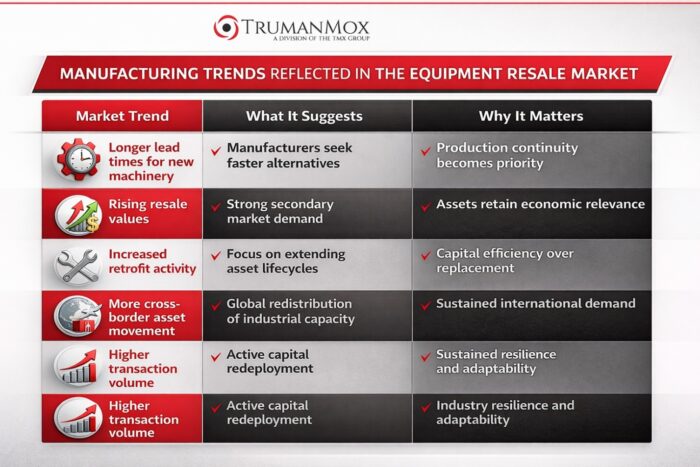
When delivery timelines for new equipment stretch months, or even years, manufacturers often look to existing market inventory to maintain production continuity.
In many cases, speed and availability outweigh the appeal of buying new.
A Shift Toward Capital Efficiency
The growth of the resale market signals a broader change in how manufacturers approach capital spending.
Rather than committing to large new-equipment investments, many companies are:
- Extending asset lifecycles
- Retrofitting older machines
- Prioritizing return on invested capital
- Preserving liquidity during economic uncertainty
This reflects a more disciplined, efficiency-driven manufacturing environment where flexibility matters.
Resilience, Not Retreat
Increased secondary-market activity is sometimes misinterpreted as a sign of contraction. In reality, it often reflects adaptability.
Manufacturers leveraging pre-owned assets are frequently:
- Responding quickly to new demand
- Filling short-term production gaps
- Entering new markets with lower upfront risk
- Managing cyclical volatility
This trend suggests that the sector remains active, just more strategic in how capital is deployed.
What Higher Used Equipment Prices Reveal
In many sectors, resale values have strengthened. That signals:
- Healthy secondary markets
- Sustained production demand
- Limited oversupply of idle machinery
- Continued industrial activity
When machinery retains value beyond its initial purchase cycle, it indicates ongoing economic relevance.
For lenders and appraisers, this reinforces the importance of real-time market analysis rather than relying on outdated assumptions.
Technology and Lifecycle Strategy
The surge in secondary transactions is not limited to legacy machines. Even relatively modern assets are trading actively.
This reflects:
- Modular upgrade pathways
- Retrofit capabilities
- Automation add-ons
- Software enhancements
Instead of replacing entire systems, manufacturers increasingly upgrade and redeploy existing platforms. Machinery is becoming part of a longer, more flexible lifecycle strategy.
Global Movement of Industrial Assets
Trade patterns also influence this market. Machinery frequently moves between:
- Domestic facilities
- International buyers
- Expanding regions
- Emerging manufacturing sectors
Efficient redistribution of industrial assets often signals sustained global production demand.
Implications for Valuation
For appraisers and financial institutions, this shift carries important implications. In dynamic markets, valuation assumptions must be grounded in current conditions, particularly as manufacturing activity fluctuates alongside broader indicators such as the Federal Reserve’s Industrial Production Index. Greater volatility in certain asset categories and stronger resale floors for in-demand machinery make real-time market analysis essential.
Is This Trend Sustainable?
While cycles inevitably shift, several structural factors suggest the resale market will remain central to manufacturing strategy:
- Ongoing supply chain variability
- Capital cost sensitivity
- Operational agility requirements
- Focus on lifecycle optimization
Even if pricing moderates, the emphasis on flexibility appears durable.
Final Thoughts
The recent used equipment boom does not signal decline, it signals evolution.
Manufacturers are becoming more strategic about capital allocation, more flexible in sourcing assets, and more disciplined in managing risk.
The trend highlights an industry focused on efficiency, responsiveness, and resilience, key indicators of where manufacturing is headed next.