

Orderly Liquidation Value is an important measure of the value of machinery and equipment. Banks often request it when evaluating equipment offered as collateral for a loan. It can also be useful during business closures, bankruptcy proceedings, workouts, and other troubled-asset situations.
Orderly Liquidation Value is commonly abbreviated as OLV. It estimates the gross amount that could be realized from a sale under specific conditions. The owner is assumed to be compelled to sell the equipment. However, the seller has a reasonable period to locate buyers and complete the sale.
OLV is not the same as Fair Market Value. It is also different from Forced Liquidation Value. Understanding these differences helps lenders and business owners make better decisions.
What Does Orderly Liquidation Value Mean?
Orderly Liquidation Value assumes that equipment is sold on an “as-is, where-is” basis. The seller is compelled to sell, but the sale does not happen immediately. There is enough time to advertise the assets and contact likely buyers.
The available marketing period depends on the appraisal assignment. A common assumption may be three to six months. However, the actual period can vary based on the equipment and circumstances.
The appraiser should clearly identify the assumed exposure period within the appraisal report. Specialized machinery, such as a Haas CNC machine, may take longer to attract a qualified buyer, while common equipment may sell more quickly.
An OLV opinion is usually lower than Fair Market Value. A compelled sale reduces the seller’s negotiating power. Buyers may also expect a discount due to the limited marketing period and “as-is” sale terms.
Why Banks Request OLV Appraisals
Banks frequently ask for OLV when machinery or equipment will be used to secure a loan. The bank needs to understand its potential recovery if the borrower defaults.
Fair Market Value may reflect a normal transaction between willing parties. That assumption does not always match a loan-default situation. A lender may need to sell the collateral within a shorter period.
OLV provides the lender with a more conservative valuation indication. It helps the lender estimate how much could be recovered through an organized sale. The estimate can also influence the loan amount or advance rate.
For example, a machine may have a Fair Market Value of $200,000. Its Orderly Liquidation Value could be much lower. The difference may reflect removal costs, limited demand, buyer risk, and the expected marketing period.
Banks may also request both Fair Market Value and OLV. The two values provide different views of the collateral. Together, they help the lender understand the asset’s normal market value and its potential liquidation recovery.
Other Reasons an OLV May Be Needed
Orderly Liquidation Value is not limited to bank financing. It may be required in several other situations.
Business owners may request it while considering a facility closure. It can help them estimate the proceeds from selling machinery over several months. This information may be important when comparing liquidation with a sale of the operating business.
Attorneys may use OLV during bankruptcy, litigation, or shareholder disputes. Accountants and financial advisors may also use it during restructuring. Equipment dealers, auctioneers, and asset-based lenders may rely on it when evaluating potential recoveries.
An OLV appraisal may also support negotiations between a lender and a troubled borrower. The value provides an independent estimate of the collateral. This can help both parties evaluate possible repayment or liquidation strategies.
How OLV Differs From Fair Market Value
Fair Market Value assumes a willing buyer and a willing seller. Neither party is under a compulsion to act. Both parties are also assumed to understand the relevant facts.
Orderly Liquidation Value assumes that the seller must sell. The assets are typically offered “as-is, where-is.” The sale also occurs within a defined and limited period.
These different assumptions can create a large difference in value. The size of that difference depends on the equipment and its market.
Common construction equipment may have an active secondary market. Examples include excavators, loaders, forklifts, and skid-steer loaders. These assets may retain a stronger percentage of Fair Market Value during an orderly liquidation.
Highly specialized manufacturing systems may face a larger discount. There may be fewer buyers for these assets. Removal, transportation, installation, and software issues can also reduce buyer interest.
Orderly Versus Forced Liquidation
Orderly Liquidation Value should not be confused with Forced Liquidation Value. Both assume that the seller is compelled to sell. The primary difference is the available sale period.
An orderly liquidation provides reasonable time for marketing. A forced liquidation usually involves a much shorter timeframe. It may assume a properly advertised public auction or another immediate sale process.
The shorter period often produces a lower value. Buyers may have less time to inspect the equipment or arrange financing. A forced sale can also limit the number of potential bidders.
OLV is often more appropriate when the lender can manage an organized disposition. Forced Liquidation Value may be useful when the assets must be sold quickly.
Gross OLV Versus Net Recovery
An appraisal should state whether the value is gross or net. This distinction can be significant.
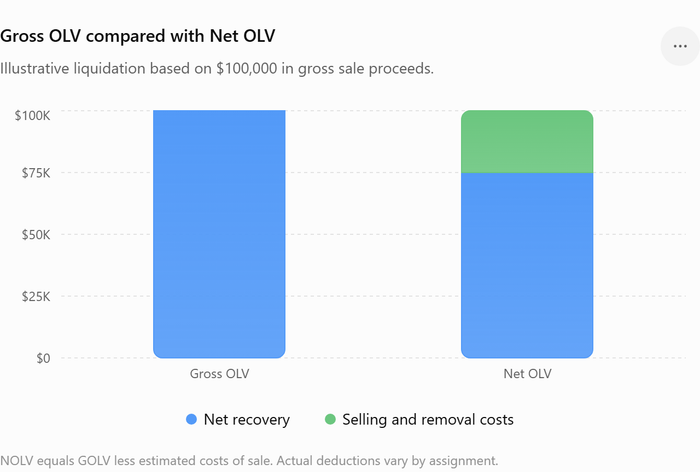
Gross Orderly Liquidation Value generally reflects the anticipated sale proceeds before selling expenses. It may not account for auction commissions, rigging, transportation, storage, or legal expenses.
Net Orderly Liquidation Value deducts applicable expenses from the expected gross proceeds. These deductions may include marketing, commissions, removal, freight, storage, cleanup, and professional fees.
Large installed machinery can be expensive to remove. In some cases, those costs can consume a substantial portion of the sale proceeds. A lender should not assume that the gross value equals the amount it will recover.
The appraisal report should clearly explain which costs are included. It should also identify any costs that were excluded.
Factors That Affect Liquidation Value
Many factors can influence an equipment liquidation. These include:
- Age and physical condition
- Hours, mileage, or production use
- Manufacturer and model
- Market demand
- Availability of replacement parts
- Software licenses and warranties
- Required removal and rigging
- Transportation costs
- Location of the equipment
- Length of the marketing period
- Number of potential buyers
- Current economic and industry conditions
The equipment’s location can be especially important. A portable machine near several buyers may be easy to sell. A large production line inside a closed facility may require extensive disassembly.
Condition documentation also matters. Buyers may discount equipment when maintenance records, operating videos, or access to inspections is unavailable.
Why a Qualified Equipment Appraiser Matters
OLV should not be estimated by applying one standard percentage to every asset. Different equipment categories behave differently in the secondary market. A qualified machinery and equipment appraiser evaluates the specific assets and relevant market evidence.
The appraiser should consider comparable sales, current listings, dealer information, auction results, and removal requirements. The analysis should also reflect the intended use of the appraisal.
An ASA-designated appraiser can prepare an appraisal that follows recognized professional standards. This is especially important when banks, attorneys, courts, or government agencies will rely on the report.
Making Informed Collateral Decisions
Orderly Liquidation Value helps estimate what equipment could generate in an orderly but compelled sale. It is commonly requested by banks for collateral lending decisions. It is also useful during closures, restructurings, bankruptcies, and business disputes.
OLV is usually lower than Fair Market Value but higher than Forced Liquidation Value. The final conclusion depends on the assets, market demand, location, condition, and assumed sale period.
A well-supported appraisal gives the intended user more than a simple percentage. It explains the market conditions, assumptions, sale terms, and expenses behind the value conclusion.