

If you’ve never gone through a professional appraisal before, an on-site visit with an equipment appraiser can feel intimidating. Business owners often wonder what will be inspected, how detailed the process is, and whether the visit will disrupt operations.
The reality is far more straightforward, and far more valuable, than most people expect.
Understanding what happens during an on-site visit with an equipment appraiser can help you prepare, reduce uncertainty, and ensure the appraisal accurately reflects your assets.
Why an On-Site Visit From an Equipment Appraiser Matters
While some valuations rely on desk reviews or limited data, a credible equipment appraisal typically includes an on-site inspection. This allows the equipment appraiser to:
- Verify the existence of assets
- Assess condition, configuration, and functionality
- Confirm asset lists and serial numbers
- Understand how equipment is used in real-world operations
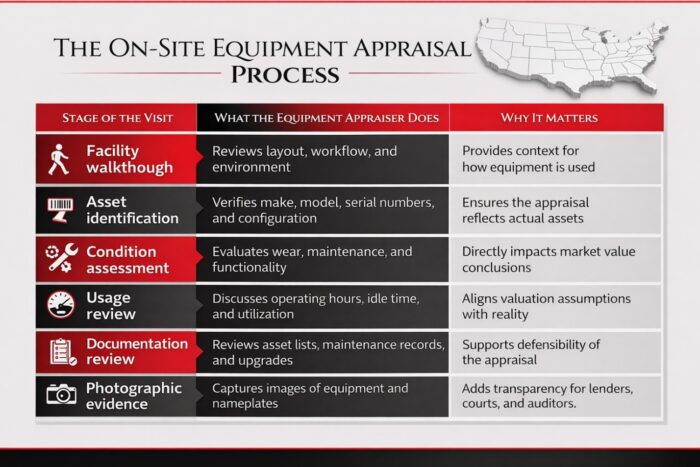
An on-site visit adds credibility, defensibility, and accuracy to the final appraisal report, especially for financing, legal, insurance, or transaction-related purposes.
Step 1: Facility Walkthrough and Asset Overview
The visit usually begins with a walkthrough of the facility. During this phase, the equipment appraiser gains context by observing:
- Facility layout and workflow
- How equipment is integrated into operations
- Environmental factors that may affect condition or longevity
This step helps the appraiser understand how assets are used, not just what they are.
Step 2: Equipment Identification and Verification
Next, the equipment appraiser systematically identifies assets, which may include:
- Machinery and production equipment
- Support equipment and tooling
- Vehicles, material handling, or specialized assets
The appraiser will typically record:
- Make, model, and manufacturer
- Serial numbers and asset tags
- Year of manufacture
- Configuration and attachments
This verification process ensures the appraisal is based on actual, observable assets, not outdated or incomplete records.
Step 3: Condition Assessment
One of the most important parts of an on-site visit is evaluating equipment condition. An experienced equipment appraiser looks beyond surface appearance to assess:
- Operational status
- Visible wear or damage
- Maintenance quality
- Modifications or upgrades
Equipment condition and maintenance history directly influence market value, particularly when proper upkeep extends usable life, as outlined in the U.S. Department of Energy’s guidance on equipment maintenance best practices.
Step 4: Usage and Operating Context
How equipment is used matters just as much as what it is.
During the visit, the equipment appraiser may ask about:
- Operating hours or duty cycles
- Idle or underutilized assets
- Production bottlenecks or redundancies
- Planned upgrades or retirements
This information helps align valuation assumptions with reality and supports more defensible conclusions.
Step 5: Documentation Review
On-site visits often include a review of available documentation, such as:
- Fixed asset lists
- Maintenance logs
- Purchase records
- Upgrade or rebuild histories
While complete records are helpful, experienced equipment appraisers are accustomed to working with partial or imperfect data.
Step 6: Photos and Supporting Evidence
Photographs are commonly taken to document:
- Equipment condition
- Configuration details
- Nameplates and serial numbers
These images support the appraisal report and add transparency for lenders, auditors, courts, or other third parties.
How Long Does an On-Site Visit Take?
The duration depends on factors like:
- Number of assets
- Facility size
- Equipment complexity
A small facility may take a few hours, while large or multi-location operations can require multiple days. A qualified equipment appraiser will coordinate timing to minimize disruption.
What an Equipment Appraiser Is Not Doing
It’s helpful to know what the visit doesn’t involve. An equipment appraiser is not:
- Auditing your business performance
- Judging operational decisions
- Attempting to sell or broker equipment
- Acting as an inspector or regulator
The focus is strictly on valuation and market relevance.
How to Prepare for an On-Site Visit With an Equipment Appraiser
To make the process smooth:
- Ensure reasonable access to equipment
- Provide asset lists if available
- Identify a point of contact for questions
That’s usually enough. Over-preparing isn’t necessary.
Why This Process Protects You
An on-site visit with an equipment appraiser results in a valuation that is:
- More accurate
- More defensible
- More credible to third parties
Whether you’re preparing for financing, a transaction, litigation, or insurance review, this level of diligence protects both you and the end user of the appraisal.
Final Thoughts
Knowing what happens during an on-site visit with an equipment appraiser removes uncertainty and sets clear expectations. The process is structured, professional, and designed to reflect real-world value, not assumptions.
A well-executed on-site appraisal isn’t just about numbers, it’s about clarity, confidence, and informed decision-making.