

Understanding the Lender’s Perspective on Equipment Collateral
When a business applies for financing backed by machinery or equipment, it’s easy to assume the process is all about numbers. But inside the bank, loan committees see things differently. They’re not just looking at what the equipment cost, they’re evaluating what it’s truly worth as collateral in a worst-case scenario.
At Truman Mox, we’ve been on both sides of the table. Our team includes former bankers and seasoned appraisers who understand the language of both risk and value. This dual perspective lets us guide clients, and their lenders, with clarity, precision, and credibility.
Why Equipment Collateral Matters More Than Most Borrowers Realize
In asset-based lending, machinery and equipment often serve as the backbone of the deal. Whether it’s a fleet of trucks, a manufacturing line, or construction equipment, lenders rely on these assets as a safety net.
But to a loan committee, equipment collateral isn’t just a line item, it’s a living, depreciating, market-sensitive asset that must be carefully evaluated. That’s why banks depend on USPAP-compliant equipment appraisals from trusted firms like Truman Mox to quantify and mitigate risk.
That’s why banks depend on USPAP-compliant equipment appraisals from trusted firms like Truman Mox to quantify and mitigate risk. For readers interested in how federal regulators define collateral evaluation standards, the Federal Reserve’s guidance on collateral valuation and management offers an excellent overview.
The Bank’s Checklist: What Really Drives the Value of Equipment Collateral
Loan committees review far more than a simple list of machines. They want assurance that each asset can back the loan if needed. The following factors make up the critical checklist behind every credit decision:
1. Condition: The First Impression That Counts
The first question a lender asks: What’s the real condition of this equipment?
Photos and spreadsheets can’t tell the whole story. Loan committees need confidence that the asset is functional, well-maintained, and not facing immediate repair costs. Detailed inspection notes, covering wear, maintenance, and operability, become key evidence in the lending file.
Pro tip: Regular maintenance logs and repair documentation don’t just keep machines running longer, they also protect your borrowing power.
2. Maintenance History: The Paper Trail of Value
Banks love data, and maintenance records tell a story they understand: stewardship, accountability, and reliability.
A clean, verifiable maintenance history can make the difference between a favorable valuation and a discounted one. At Truman Mox, we’ve seen identical machines valued thousands of dollars apart simply because one had complete service records, and the other didn’t.
In short: Maintenance = Value. Poor maintenance = Risk.
3. Marketability: How Easily Could the Asset Be Sold?
Even well-maintained assets must be marketable. Loan committees want to know: If we had to liquidate, how quickly could we sell it?
They prefer equipment with an active secondary market, strong demand, and resale infrastructure. For instance, a popular excavator model may sell overnight; a custom-built production system could sit for months.
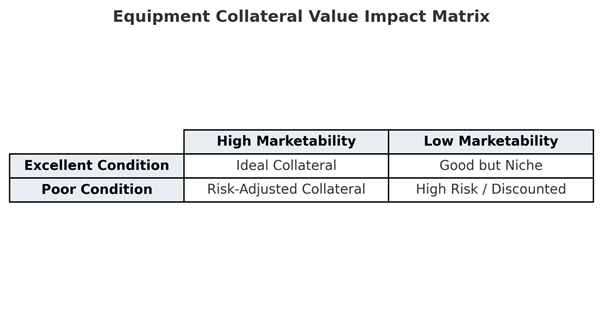
That’s why Truman Mox appraisers research real-time market data, auction results, and comparable sales, not just book values, to give lenders a full picture of marketability.
4. Obsolescence: The Silent Value Killer
Technological change moves fast. Even a well-maintained asset can lose value overnight if newer, more efficient technology replaces it.
Truman Mox appraisers analyze:
- Physical obsolescence: Wear and tear or aging components.
- Functional obsolescence: Reduced performance or outdated features.
- Economic obsolescence: Market trends that make the asset less desirable.
Recognizing these risks helps lenders make informed loan-to-value (LTV) decisions.
5. Liquidation Value: The Bank’s True Safety Net
Ultimately, lenders want to know what the asset is worth if the loan defaults. Liquidation value, whether orderly or forced, defines the floor of recovery.
Our team provides multiple valuation scenarios:
- Fair Market Value (FMV)
- Orderly Liquidation Value (OLV)
- Forced Liquidation Value (FLV)
This layered insight gives lenders the full risk picture they need for credit decisions.
Why Truman Mox Understands Both Sides of the Equation
Because our team includes former bankers and credit professionals, we understand how loan committees think, from underwriting standards to regulatory compliance.
Our reports are:
- USPAP-compliant and audit-ready
- Backed by market data and comparable sales
- Tailored with clear executive summaries
In short, Truman Mox appraisals are built for bank review, not just for file storage.
Final Thoughts: Confidence Through Clarity
Accurate equipment valuation isn’t about inflating numbers, it’s about establishing trust and transparency between borrower and lender.
When banks know the collateral is backed by a credible, data-driven appraisal, they can make faster, more confident lending decisions. And when borrowers partner with Truman Mox, they gain a partner fluent in both finance and machinery value.