
Replacement Cost New (RCN) is an important concept in machinery and equipment appraisal. It represents the cost to replace an existing asset with a new one that offers similar utility. Appraisers often use Replacement Cost New when applying the cost approach to equipment valuation.
Understanding RCN helps business owners, lenders, and other professionals interpret equipment values. However, replacement cost does not automatically represent what an asset could sell for in the market.
What Is Replacement Cost New?
Replacement Cost New refers to the estimated cost of acquiring a new asset with equivalent utility to an existing one. The replacement does not need to be identical. Instead, it must perform the same essential functions and provide comparable service.
For example, an older manufacturing machine may no longer be available from its original manufacturer. In that case, an appraiser may research a modern machine that performs the same work at a similar capacity.
The estimated replacement cost may exceed the equipment’s purchase price. Depending on the appraisal assignment, it may also account for freight, installation, and other costs needed to place the asset into service.
As a result, RCN provides a starting point for evaluating an asset under the cost approach.
How Do Appraisers Calculate RCN?
Appraisers estimate RCN by researching the cost of obtaining a new asset with comparable utility. They consider the equipment’s function, capacity, specifications, and available alternatives.
First, the appraiser identifies the asset and its intended function. Next, they research current equipment options that could perform the same work. Finally, they evaluate the costs relevant to the appraisal’s intended use and valuation premise.
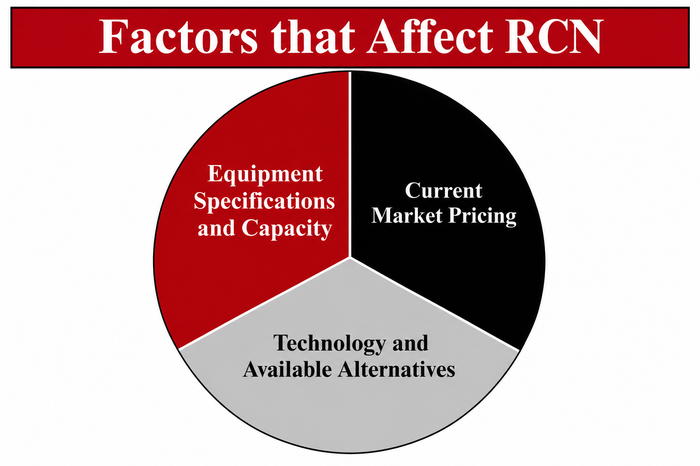
Several factors can influence the estimate:
- Equipment specifications: Capacity, size, output, and technical capabilities help identify suitable replacements.
- Current equipment pricing: Manufacturer quotations, dealer information, and reliable market data support replacement cost estimates.
- Technology: Modern equipment may provide similar utility through different designs or features.
- Freight and installation: Transportation, setup, and related expenses may affect the total replacement cost.
- Availability: The equipment available on the valuation date can influence the selection of a suitable replacement.
The appraiser must also consider the asset’s location and the conditions relevant to the assignment. Therefore, two similar machines may require different cost estimates when their circumstances differ.
Understanding Equipment Depreciation
Replacement Cost New represents the cost of a new asset with equivalent utility. However, an existing machine may have years of use, wear, or outdated features.
For this reason, appraisers consider depreciation when applying the cost approach. In appraisal terminology, depreciation reflects a loss in value from one or more causes.
Three common forms of depreciation include physical deterioration, functional obsolescence, and economic obsolescence.
Physical deterioration reflects wear, damage, and other effects of age or use. For example, a machine with worn components may require repairs to maintain its performance.
Functional obsolescence occurs when an asset has limitations compared with available alternatives. An older production system may use more energy or require additional labor.
Economic obsolescence results from external conditions that affect an asset’s value. Changes in industry demand, regulations, or market conditions may contribute to this form of depreciation.
Consequently, an appraiser may adjust RCN to reflect the depreciation that applies to the existing equipment. The resulting cost approach indication must then be evaluated in light of the assignment’s value definition and market conditions.
Replacement Cost vs. Reproduction Cost
Although these terms sound similar, they describe different cost concepts.
Replacement Cost New estimates the cost of a new asset that provides equivalent utility. Reproduction Cost New estimates the cost of creating an exact replica of the existing asset using the same design and specifications.
Consider a specialized manufacturing machine built several decades ago. Reproducing that machine could require custom parts and outdated manufacturing methods. However, a modern replacement might perform the same work more efficiently.
In this situation, replacement cost may offer a more practical basis for the cost approach. Still, the appropriate method depends on the equipment and the appraisal assignment.
The distinction matters because the cost of recreating an asset may differ substantially from the cost of replacing its useful functions.
Example of RCN in Equipment Appraisal
Consider a hypothetical manufacturing company that owns an older industrial machine. The equipment remains operational, but the manufacturer no longer produces that model.
An appraiser researches modern equipment with comparable production capacity and utility. After reviewing suitable alternatives, the appraiser estimates a Replacement Cost New of $150,000.
The appraiser then examines the existing machine’s age, physical condition, efficiency, and external market conditions.
For illustration, assume the supported depreciation adjustments total $60,000. Subtracting those adjustments from RCN produces a cost approach indication of $90,000.
This example is hypothetical and does not represent an actual appraisal. The figures are illustrative, and real depreciation adjustments require supporting analysis.
Importantly, the $90,000 indication does not automatically equal Fair Market Value or liquidation value. Those conclusions depend on the applicable value definition, market evidence, and other assignment conditions.
Why the Cost Approach Matters
Replacement Cost New helps establish a cost-based reference point when conducting a professional machinery and equipment appraisal
It can be especially useful for specialized assets that have limited comparable sales data. In these cases, researching equivalent new equipment may help an appraiser develop a supported value indication.
However, RCN is only one part of the valuation process. Appraisers must consider the intended use, applicable value definition, asset condition, and available market information.
For example, an appraisal prepared for financial reporting may involve different requirements than one prepared for collateral lending. Likewise, an insurance assignment may use a replacement cost definition that differs from the one used in a market value appraisal.
Therefore, the appropriate valuation method depends on the purpose and scope of the assignment.
Appraisers also follow professional appraisal standards to ensure their valuation methods are appropriate, consistent, and supported by reliable research.
Understanding RCN With Truman Mox
Replacement Cost New provides an important foundation for understanding the cost approach to machinery and equipment appraisal. With appropriate research and depreciation analysis, it helps appraisers evaluate assets with limited direct market comparisons.
At Truman Mox, we specialize in machinery, equipment, inventory, and furniture, fixtures, and equipment (FF&E) appraisals. Our team works with businesses, lenders, and other professionals across the United States.
If you need a professional equipment valuation, contact Truman Mox to discuss your appraisal needs and the appropriate approach for your assignment.