

Remote valuations are equipment and machinery appraisals conducted without a physical on-site inspection. Instead of traveling to a facility, a certified appraiser evaluates assets using detailed documentation, photographs, video, maintenance records, and current market data.
For lenders, business owners, attorneys, and financial professionals, remote valuations can provide an efficient and cost-effective way to determine equipment value when the circumstances are appropriate.
Unlike informal price estimates, professional remote valuations still follow established appraisal standards and methodologies. The difference lies in how inspection data is gathered, not in the analytical rigor applied to the assignment.
How Remote Valuations Work Step by Step
Understanding how remote valuations work helps clarify when they are credible and when an on-site inspection may be required.
1. Defining the Scope of Work
Every valuation begins by identifying:
- Intended use (loan underwriting, financial reporting, litigation, internal planning)
- Intended users
- Definition of value (Fair Market Value, Orderly Liquidation Value, Forced Liquidation Value, etc.)
- Effective date of valuation
The scope of work determines the depth of research and reporting required.
2. Asset Identification and Documentation
Because there is no physical inspection, documentation becomes critical. Clients are typically asked to provide:
- Detailed equipment lists
- Make, model, and serial numbers
- Year of manufacture
- Purchase invoices (if available)
- Maintenance and service records
- Clear, recent photographs (multiple angles)
- Videos showing equipment in operation when possible
The reliability of remote valuations is directly tied to the quality and completeness of this information.
3. Condition Assessment
Condition is one of the most important drivers of equipment value. In remote valuations, condition is assessed based on:
- Photographic evidence
- Maintenance history
- Usage levels
- Reported operational status
- Industry expectations for similar assets
Appraisers may conduct interviews with management or equipment operators to clarify condition and functionality.
4. Market Research and Comparable Analysis
Market research remains the foundation of credible remote valuations. Appraisers analyze:
- Recent auction results
- Dealer listings
- Private sale transactions
- Supply and demand trends
- Replacement cost data
Comparable sales are adjusted for age, configuration, condition, and geographic factors to arrive at a supported conclusion of value.
5. Report Preparation and Disclosure
A properly prepared remote valuation report clearly discloses:
- The reliance on client-provided information
- Assumptions and limiting conditions
- The absence of a physical inspection
- The methodology applied
Transparency ensures that intended users understand both the strengths and limitations of the assignment.
When Remote Valuations Are Appropriate
Remote valuations can be highly effective in certain situations.
Portfolio Monitoring for Lenders
Financial institutions often need updated collateral positions across multiple borrowers. When assets are standard, well-documented, and not distressed, remote valuations can efficiently support ongoing risk management.
Secondary or Update Appraisals
If a recent on-site inspection has already been conducted, a remote update may be appropriate to reflect current market conditions.
Low-to-Moderate Risk Transactions
Established businesses with consistent asset types and strong documentation are often good candidates for remote valuations.
Geographically Dispersed Assets
When equipment is located in multiple states, remote analysis can streamline initial evaluation before determining whether selective site visits are necessary.
Time-Sensitive Transactions
In refinancing or restructuring scenarios where timing is critical, remote valuations may provide faster turnaround.
When Remote Valuations May Not Be Appropriate
Despite their advantages, remote appraisals are not suitable in every circumstance.
Distressed or Workout Situations
In default, bankruptcy, or liquidation scenarios, physical inspection is often necessary to verify condition, completeness, and marketability.
Highly Specialized or Custom Equipment
Unique, modified, or proprietary machinery may require hands-on inspection to properly assess configuration and remaining useful life.
Incomplete or Poor Documentation
If asset lists are inaccurate or photographs are outdated or unclear, the credibility of a remote valuation is reduced.
Litigation and High-Scrutiny Assignments
When valuation conclusions may be challenged in court, an on-site inspection often strengthens defensibility.
Condition-Sensitive Assets
Equipment exposed to heavy wear, corrosion, environmental damage, or deferred maintenance may require in-person evaluation.
Benefits of Remote Valuations
When used in the right context, remote valuations offer several advantages:
Efficiency
Eliminating travel reduces scheduling delays.
Cost Control
Lower logistical expenses can benefit both lenders and business owners.
Scalability
Large portfolios can be reviewed more efficiently.
Accessibility
Assets across multiple locations can be analyzed without geographic constraints.
Risks and Limitations to Consider
Remote appraisals rely heavily on third-party information. Potential risks include:
- Undisclosed damage
- Missing components
- Inaccurate asset records
- Overstated condition
- Outdated images
A qualified appraiser mitigates these risks through:
- Detailed documentation requirements
- Conservative assumptions when necessary
- Thorough market support
- Clear report disclosures
However, remote analysis cannot fully replace physical verification in high-risk scenarios.
Best Practices for a Successful Remote Valuation
If you are considering a remote valuation, preparation is essential.
- Provide a complete and organized asset list.
- Submit clear, recent photographs from multiple angles.
- Include maintenance and service documentation.
- Disclose known issues upfront.
- Be available for follow-up clarification questions.
The more accurate the information provided, the more reliable the valuation outcome.
Choosing the Right Approach: Remote Valuations or On-Site Valuations?
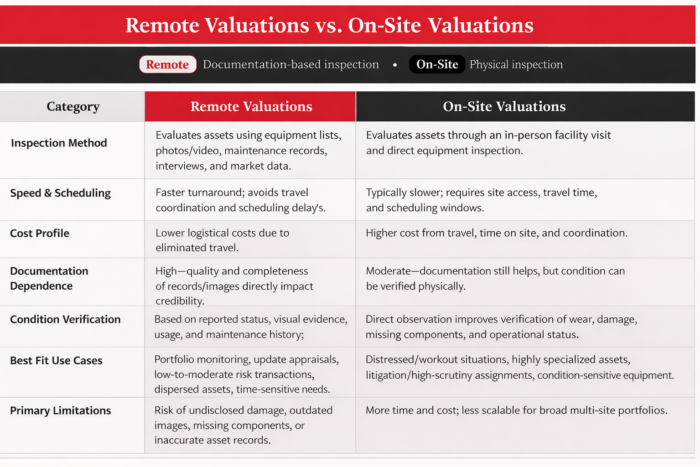
Remote appraisals are a practical and effective tool in modern equipment appraisal practice. When properly scoped and supported by credible documentation and market research, they can provide reliable value conclusions for lenders, business owners, and financial professionals.
However, they are not a substitute for on-site inspection in every situation. The decision to use remote valuations should be based on asset complexity, risk level, intended use, and documentation quality.
Consulting with a certified machinery and equipment appraiser can help determine whether a remote valuation or physical inspection is the appropriate solution for your specific needs.