

A heavy machinery appraisal checklist helps equipment owners and lenders accurately evaluate industrial assets across the construction, transportation, manufacturing, mining, and logistics industries. From excavators and bulldozers to cranes and industrial automation systems, machinery investments often represent a significant portion of a company’s operational infrastructure. Because these assets directly impact financing, insurance, resale opportunities, and long-term business planning, understanding machinery value has become increasingly important for both equipment owners and lenders.
A professional heavy machinery appraisal checklist helps businesses evaluate industrial equipment accurately while supporting better financial decision-making. A complete heavy machinery appraisal checklist also helps lenders reduce risk and improve collateral analysis. Whether a company is pursuing equipment financing, preparing for a merger, restructuring operations, or updating insurance coverage, machinery appraisals provide an objective assessment of asset value based on current market conditions.
As industrial markets continue evolving through technology upgrades, fluctuating demand, and changing economic conditions, professional equipment valuation services are becoming more essential across nearly every heavy equipment sector.
Why Heavy Machinery Appraisals Matter in Today’s Market
Heavy machinery often carries substantial financial value, making accurate equipment valuation critical for businesses and financial institutions alike. Construction companies, warehouse operators, agricultural firms, and manufacturing facilities frequently rely on large fleets of industrial assets that depreciate over time while market demand constantly shifts.
Without accurate valuation reporting, businesses may struggle to determine the true financial position of their equipment portfolios. In many cases, outdated or inaccurate valuations can lead to financing complications, insurance gaps, tax reporting issues, or poor asset management decisions.
Heavy machinery appraisals are commonly used for:
- Equipment financing applications
- SBA loan support
- Insurance claims and coverage reviews
- Business acquisitions and mergers
- Bankruptcy and restructuring cases
- Asset liquidation planning
- Internal accounting compliance
- Fleet management analysis
Lenders also depend heavily on professional machinery appraisals because industrial equipment frequently serves as collateral during financing transactions. Reliable valuation reports help lenders reduce risk while establishing accurate loan-to-value ratios.
In today’s competitive industrial economy, businesses increasingly rely on updated equipment appraisals to improve budgeting, operational planning, and long-term asset recovery strategies.
What Is a Heavy Machinery Appraisal?
A heavy machinery appraisal is a professional valuation process used to determine the fair market value, orderly liquidation value, or replacement cost of industrial equipment. Certified appraisers analyze machinery using recognized methodologies that account for market demand, equipment condition, depreciation, operating performance, and comparable sales activity.
The appraisal process combines physical equipment inspection with market research and financial analysis. Appraisers evaluate both the technical condition of machinery and the broader economic environment influencing resale demand.
Most heavy equipment appraisals focus on several primary valuation categories, including:
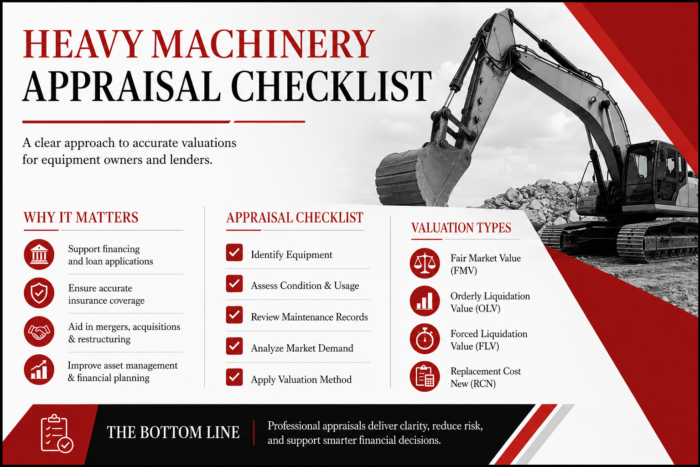
- Fair Market Value (FMV)
- Orderly Liquidation Value (OLV)
- Forced Liquidation Value (FLV)
- Replacement Cost New (RCN)
These valuation methods provide businesses and lenders with different perspectives depending on the purpose of the appraisal. For example, financing transactions may rely heavily on fair market value, while liquidation proceedings often focus on orderly or forced liquidation value.
Professional equipment appraisals can apply to individual assets, entire fleets, or complete industrial facilities depending on the scope of the engagement.
Complete Heavy Machinery Appraisal Checklist for Equipment Owners & Lenders
An effective heavy machinery appraisal checklist ensures every major valuation factor is reviewed carefully before assigning a final equipment value. One of the first steps in the process involves accurate equipment identification. Appraisers document the manufacturer, model number, serial number, year of manufacture, and equipment category to establish the foundation for the valuation analysis.
Physical condition assessment is another critical component of the appraisal process. Machinery condition significantly impacts both resale value and financing eligibility. During inspections, appraisers evaluate engine performance, hydraulic systems, structural integrity, electrical systems, wear patterns, and operational functionality.
Equipment with strong maintenance histories and minimal operational damage typically retains higher market value than poorly maintained machinery. Appraisers also review hour meter readings because usage often affects value more heavily than equipment age alone. Machinery exposed to demanding environments such as mining or demolition may experience accelerated depreciation compared to equipment used under lighter operating conditions.
Maintenance documentation also plays a major role during industrial equipment valuation. Service records help appraisers understand how consistently the equipment has been maintained over time. Well-documented machinery often receives stronger valuations because buyers and lenders view the assets as lower-risk investments.
Important documentation may include:
- Preventive maintenance schedules
- Repair and service invoices
- Inspection reports
- Warranty documentation
- Component replacement history
- Ownership records
Market demand analysis further strengthens the appraisal process. Industrial equipment values fluctuate based on economic activity, construction demand, supply chain conditions, and resale market trends. Appraisers review dealer pricing, auction activity, and regional demand patterns to establish realistic market benchmarks for each machinery category.
Ownership verification is equally important, especially for lenders using equipment as collateral. Clear ownership documentation helps protect all parties involved during financing transactions while reducing legal and financial risk.
Common Types of Heavy Machinery Included in Appraisals
Heavy machinery appraisals may involve a wide variety of industrial assets across multiple sectors. Construction equipment remains one of the largest categories, including excavators, wheel loaders, cranes, bulldozers, dump trucks, and asphalt paving equipment.
Manufacturing operations often require appraisals for:
- CNC machinery
- Robotic systems
- Industrial compressors
- Conveyor systems
- Packaging equipment
- Material handling systems
Warehouse and logistics facilities frequently seek valuations for forklifts, fleet vehicles, warehouse automation systems, and transportation equipment. Agricultural businesses may require appraisals for tractors, irrigation systems, combines, and harvesting machinery.
Energy, mining, and infrastructure companies also depend heavily on professional machinery appraisals because their industrial assets often carry extremely high replacement costs and financing exposure.
Key Factors That Affect Heavy Equipment Value
Several important variables influence heavy equipment valuation outcomes. One of the most significant factors is depreciation. Industrial machinery naturally loses value over time due to wear, operational usage, and technological obsolescence. However, depreciation rates vary substantially depending on equipment type, operating environment, and maintenance quality.
Equipment condition remains another major valuation factor. Machinery that has been properly serviced and maintained generally retains stronger resale potential than equipment with visible structural damage or inconsistent maintenance histories.
Brand reputation can also affect equipment pricing. Machinery produced by well-established manufacturers often maintains stronger resale value because buyers trust the reliability, dealer support, and long-term parts availability associated with recognized brands.
Additional valuation factors may include:
- Operating hours
- Regional demand conditions
- Fuel efficiency
- Technology upgrades
- Safety features
- Equipment scarcity
- Market competition
Economic conditions further influence industrial equipment values. During periods of strong construction or infrastructure growth, machinery demand often rises substantially. Conversely, economic slowdowns may weaken resale pricing across multiple industrial sectors.
Modern technology also plays an increasing role in machinery valuation. Equipment equipped with telematics, automation systems, fuel-saving technology, and advanced safety controls may command premium pricing compared to outdated machinery models.
Challenges in Heavy Equipment Valuation
Heavy equipment valuation involves several challenges that require specialized market expertise and technical knowledge. Industrial equipment markets can shift rapidly due to changing economic conditions, tariffs, supply chain disruptions, and fluctuations in commodity pricing.
Specialized machinery categories may present additional complexity because limited resale activity can make comparable market analysis more difficult. Certain custom-built industrial assets may have few recent transactions available for accurate benchmarking.
Geographic location also impacts machinery value. Equipment located in regions experiencing strong industrial growth or construction demand may carry significantly different valuations compared to machinery located in slower economic markets.
Other common valuation challenges include:
- Equipment modifications and upgrades
- Incomplete maintenance records
- Market volatility
- Limited auction data
- Technology obsolescence
- Transportation and relocation costs
These challenges highlight why businesses and lenders often rely on experienced appraisal professionals with deep knowledge of industrial machinery markets.
How Lenders Use Heavy Machinery Appraisals
Lenders rely heavily on machinery appraisals when evaluating collateral-backed financing opportunities. Accurate equipment valuation helps financial institutions determine loan-to-value ratios while reducing exposure to lending risk.
Heavy machinery appraisals support a variety of financial transactions, including equipment refinancing, SBA lending, business acquisitions, and restructuring projects. Independent appraisal reports provide lenders with objective analysis while improving underwriting transparency.
Professional equipment appraisals help lenders:
- Validate collateral value
- Reduce financing risk
- Improve portfolio management
- Support underwriting compliance
- Strengthen asset recovery planning
- Evaluate liquidation potential
As asset-based lending continues expanding throughout industrial sectors, professional machinery appraisals have become increasingly important for both borrowers and financial institutions.
Why Professional Equipment Appraisals Improve Asset Decisions
Professional machinery appraisals provide businesses with valuable financial insight that supports stronger operational and investment decisions. Updated equipment valuations help organizations improve budgeting accuracy, strengthen insurance planning, and optimize asset management strategies across multiple business functions.
An independent appraisal can also help companies identify underperforming assets, evaluate equipment replacement timelines, and improve long-term fleet planning. During mergers, acquisitions, or restructuring events, accurate valuation reporting ensures businesses fully understand the financial position of their industrial assets.
As industrial markets continue evolving through automation, modernization, and economic change, professional heavy equipment appraisal services will remain essential for equipment owners, lenders, and investors seeking accurate asset valuation support.
Businesses looking for professional industrial valuation services can learn more about heavy equipment appraisals and asset valuation solutions through Truman Mox and explore additional equipment appraisal industry insights.