
A Florida CNC Appraisal is often necessary because CNC machinery can represent a substantial portion of a manufacturing business’s tangible assets. CNC equipment includes machining centers, turning centers, lathes, mills, Swiss-type machines, EDM equipment, routers, grinders, and other manufacturing systems. These machines can vary significantly in value based on their specifications, age, condition, configuration, and market demand. Individual CNC machines can range from relatively modest values to hundreds of thousands of dollars per machine.
Business owners, lenders, attorneys, accountants, trustees, and other professionals may need to understand the value of CNC equipment. A qualified Florida CNC Appraisal can provide an independent and supportable opinion of value.
However, one of the most important considerations in any CNC machinery appraisal is its intended use. There is no single definition of “value” that applies to every assignment. A CNC machine may have significantly different values depending on the intended use of the appraisal. Lending, divorce, bankruptcy, charitable donation, estate planning, financial reporting, and liquidation may require different value standards.
Before beginning an appraisal, the appraiser should understand why the appraisal is being performed, who will rely upon the report, the appropriate effective date, and the applicable definition or definitions of value.
Florida CNC Appraisal: Why the Intended Use Determines the Appropriate Value
A Florida CNC Appraisal should be developed around the intended use of the assignment. The reason for the appraisal frequently determines which definition of value is appropriate.
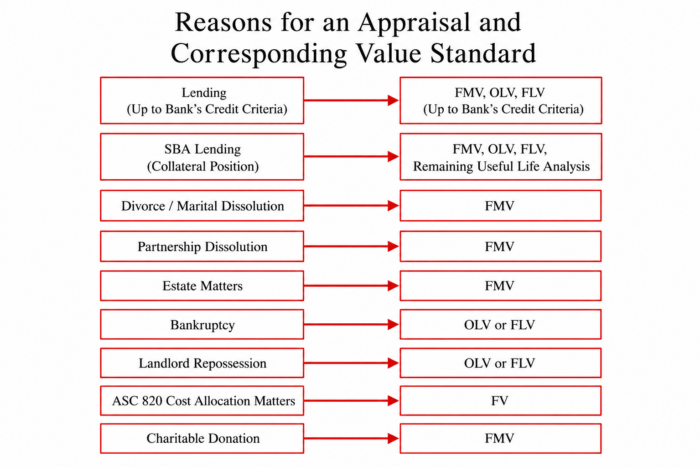
For example, a bank considering CNC machinery as collateral for a loan may be concerned with both the equipment’s value under normal market conditions and the amount that could be recovered if the borrower defaults. A divorcing couple, on the other hand, may primarily require Fair Market Value. A bankruptcy matter may require an analysis based upon a liquidation premise.
These are fundamentally different valuation questions.
The appropriate definition of value should be established at the beginning of the appraisal assignment. Fair Market Value should not be automatically assumed to apply in every situation.
Lending and Loan Collateral
CNC machinery is frequently pledged as collateral for commercial lending transactions, equipment financing, refinancing, acquisitions, and other credit facilities.
A conventional lender may request:
Fair Market Value (FMV)
Orderly Liquidation Value (OLV)
Forced Liquidation Value (FLV)
The exact valuation requirements ultimately depend on the bank or lender and its credit criteria. Some financial institutions may require all three values, while others may request only one or two.
Fair Market Value generally addresses the anticipated value of the equipment when adequate time is available for exposure to the appropriate market, and neither party is under compulsion to transact.
Orderly Liquidation Value considers a more limited marketing period and the orderly sale of the assets.
Forced Liquidation Value generally contemplates a substantially compressed sale period and circumstances in which the assets must be sold quickly.
For a lender, these distinctions can be important. A CNC machining center may have a reasonable Fair Market Value when marketed individually to an end user. However, it could realize considerably less if sold quickly as part of a liquidation.
The appraiser should clearly identify the definitions of value used within the report and apply the appropriate market evidence and valuation methodology to each premise.
SBA Lending
When the U.S. Small Business Administration (SBA) is in the collateral position, and a machinery and equipment appraisal is required, the appraisal requirements can be more extensive.
Depending upon the applicable SBA requirements and assignment circumstances, the appraisal may require:
Fair Market Value
Orderly Liquidation Value
Forced Liquidation Value
Remaining Useful Life Analysis
Remaining Useful Life can be particularly important when CNC machinery is being relied upon as collateral. Age alone does not necessarily determine the remaining economic or functional life of CNC equipment.
An appraiser may consider factors such as the machine’s manufacturer, model, year, operating hours, maintenance history, controls, technological relevance, rebuild history, availability of replacement components, current market acceptance, and overall utility.
A 15-year-old CNC machine from an established manufacturer with readily available parts and controls may have considerably different remaining useful life characteristics than another machine of the same age with obsolete controls and limited manufacturer support.
Florida CNC Appraisal for Divorce and Marital Dissolution
A Florida CNC Appraisal may also be required when CNC machinery is owned by a business involved in divorce or marital dissolution proceedings.
Fair Market Value is typically the relevant value requested for these assignments. However, the appropriate definition should be confirmed based on the circumstances, jurisdiction, and instructions from legal counsel..
CNC machinery can pose particular valuation challenges in divorce matters because accounting records and book values may bear little relation to current market value.
A machine that has been substantially depreciated for accounting purposes could still have meaningful secondary-market value. Conversely, a machine purchased for a substantial amount several years earlier may have experienced considerable technological or economic obsolescence.
An independent appraisal can help establish a supportable value for the machinery. It avoids relying solely on purchase price, net book value, or estimates from either party.
Partnership Dissolution and Business Disputes
Partnership dissolutions, shareholder disputes, buyouts, and other business separations can also necessitate an appraisal.
Fair Market Value is typically used in these situations, subject to the terms of the partnership agreement, buy-sell agreement, legal instructions, or other governing documents.
An independent CNC appraisal can help establish a common valuation framework when the parties have competing financial interests.
This may be particularly important when machinery represents a significant portion of the company’s tangible asset base.
Florida CNC Appraisal for Estate Matters
Estate planning and estate settlement can require the valuation of machinery owned personally or through a closely held business.
Fair Market Value is typically required for estate-related matters. However, the exact valuation requirements should be determined with the appropriate legal and tax professionals.
A Florida CNC Appraisal can document the machinery inventory and provide a supportable opinion of value as of the applicable effective date.
This becomes especially important when an estate includes a manufacturing business with substantial CNC equipment. The estate may also include tooling, support equipment, and other tangible assets.
Florida CNC Appraisal for Bankruptcy
Bankruptcy presents a different valuation environment because the appropriate premise of value can depend heavily upon the circumstances of the case and the anticipated disposition of the assets.
A CNC machinery appraisal performed for bankruptcy purposes could require Orderly Liquidation Value or Forced Liquidation Value.
If the machinery can be marketed over a reasonable period, an Orderly Liquidation Value premise may be appropriate. If the assets must be sold rapidly, Forced Liquidation Value may better reflect the circumstances.
The distinction can materially affect the valuation.
CNC machinery is often specialized, and the pool of qualified buyers may be limited. Rigging expenses, transportation costs, electrical requirements, machine size, control technology, tooling compatibility, and geographic location can all affect marketability.
The appraiser should understand the anticipated disposition scenario before selecting and applying a liquidation premise.
Landlord Repossession
Landlords can unexpectedly find themselves in possession of CNC machinery and manufacturing equipment when a tenant defaults, abandons a facility, or otherwise leaves equipment behind.
In these circumstances, the relevant valuation may be either the Orderly Liquidation Value or the Forced Liquidation Value.
The appropriate premise largely depends on how much time the landlord has to dispose of the machinery.
If the landlord can retain the equipment at the property and conduct a structured marketing process, OLV may be appropriate. If the building must be cleared rapidly for another tenant, FLV may become more relevant.
The costs associated with removing CNC machinery should also be considered when evaluating the practical disposition of the assets. Large machining centers may require specialized riggers, electrical disconnection, loading equipment, permits, and transportation.
Florida CNC Appraisal for ASC 820 and Cost Allocation Matters
Financial reporting and cost allocation assignments can require a different valuation standard than traditional equipment appraisal assignments.
For matters governed by ASC 820, Fair Value (FV) may be required.
Fair Value is distinct from Fair Market Value and should not be treated as interchangeable terminology. ASC 820 establishes a framework for measuring fair value for financial reporting purposes, with an emphasis on market participant assumptions and an orderly transaction in the principal or most advantageous market.
A Florida CNC Appraisal performed as part of a financial reporting or cost allocation engagement should therefore be developed in coordination with the applicable accounting requirements and the broader valuation assignment.
The appraiser may also need to work with accountants, auditors, valuation professionals, or transaction advisors to ensure that the machinery analysis is consistent with the overall engagement.
Florida CNC Appraisal for Charitable Donation
Businesses and individuals may donate CNC machinery, machine tools, and other manufacturing equipment to qualified charitable organizations, educational institutions, vocational programs, or other eligible recipients.
Fair Market Value is generally the relevant standard for charitable donation appraisal purposes.
When the applicable tax requirements call for a qualified appraisal, the report should provide sufficient documentation to support the concluded value and comply with the applicable appraisal and reporting requirements. Depending upon the transaction, IRS Form 8283 and related documentation may also be involved.
Because charitable contribution appraisals are subject to regulatory and tax requirements, the appraisal should be developed specifically for the intended use rather than repurposing one originally prepared for lending, insurance, or another purpose.
Florida CNC Appraisal: Factors That Affect CNC Machinery Value
Regardless of the intended use, determining the value of CNC machinery requires considerably more analysis than simply identifying the original purchase price and applying depreciation.
A Florida CNC Appraisal may consider the manufacturer, model, year of manufacture, machine configuration, CNC control, spindle hours, operating hours, axis configuration, table size, spindle speed, horsepower, tooling, automation, probing systems, chip management systems, coolant equipment, bar feeders, pallet systems, rotary tables, software, accessories, and other components.
Manufacturer reputation can also have a substantial impact on secondary-market demand. Equipment manufactured by companies such as Haas, Mazak, Okuma, DMG Mori, Doosan/DN Solutions, Makino, Hurco, Hyundai Wia, Brother, Citizen, Tsugami, Star, Hardinge, and other established manufacturers may have very different secondary-market characteristics.
Control technology is another important consideration. CNC controls can become technologically obsolete before the machine’s mechanical structure reaches the end of its physical life.
The market may discount otherwise operational machinery when replacement controls, electronic components, drives, boards, or manufacturer support become difficult to obtain.
Florida CNC Appraisal and the Importance of Equipment Identification
Accurate equipment identification is an important part of a credible Florida CNC Appraisal.
Whenever available, the appraiser should identify information such as the manufacturer, model, serial number, year, control system, capacity, configuration, and major accessories.
Two CNC machining centers from the same manufacturer and model series can have materially different values because of differences in age, spindle configuration, controls, hours, tooling packages, probing systems, rotary equipment, automation, or other options.
This is why relying exclusively upon generic depreciation tables or broad equipment categories can produce misleading results.
Market Approach and Cost Approach Considerations
The Market Approach is frequently applicable to CNC machinery because an active secondary market exists for many commonly traded machines.
The appraiser can research comparable CNC equipment currently offered for sale and, when available, historical transactions and auction results. Adjustments may then be considered for differences in age, configuration, capacity, condition, controls, accessories, market conditions, and other relevant characteristics.
However, asking prices should not automatically be treated as completed transactions. Dealers may negotiate from advertised prices, and the circumstances surrounding auction transactions can differ considerably from those in normal market transactions.
For specialized CNC systems where meaningful comparable market information is limited, the Cost Approach may also be considered. Under the Cost Approach, the appraiser analyzes replacement or reproduction cost and considers physical deterioration, functional obsolescence, and economic obsolescence when applicable.
The appropriate methodology depends on the subject assets, the availability and quality of market data, the intended use, and the definition of value.
One Machine Can Have Several Different Values
One of the most important concepts for users of machinery appraisals to understand is that the same CNC machine can legitimately have several different values on the same effective date.
Consider a CNC machining center that could reasonably sell to an end user after adequate market exposure. That machine’s Fair Market Value may be substantially higher than the amount expected from a shortened liquidation process.
If the same machine must be sold rapidly at auction with limited marketing exposure, the Forced Liquidation Value could be lower still.
None of these values is necessarily “wrong.”
They answer different valuation questions.
This is why an appraisal should never begin with the question, “What is this CNC machine worth?”
The more appropriate question is:
“What is this CNC machine worth, under what definition of value, as of what date, and for what intended use?”
Choosing a Florida CNC Appraisal Firm
CNC machinery can be technically complex and financially significant. An appraisal firm should understand both machinery and the valuation principles necessary to develop a supportable opinion of value.
Truman Mox provides machinery and equipment appraisal services throughout Florida and nationwide. Our appraisal assignments can include individual CNC machines, complete machine shops, precision manufacturing facilities, aerospace manufacturing equipment, production machinery, fabrication equipment, and other industrial assets.
Depending upon the intended use of the assignment, the appraisal can address Fair Market Value, Orderly Liquidation Value, Forced Liquidation Value, Fair Value, and Remaining Useful Life where applicable.
Whether the appraisal is required for lending, SBA collateral requirements, divorce, partnership dissolution, estate matters, bankruptcy, landlord repossession, ASC 820 financial reporting matters, charitable donation, or another business purpose, the first step is establishing the appropriate scope and definition of value.
Florida CNC Appraisal Services from Truman Mox
A properly developed Florida CNC Appraisal should do more than assign numbers to a machinery list. It should identify the assets being valued, establish the intended use and applicable definitions of value, analyze relevant market information, apply appropriate valuation methodologies, and provide sufficient support for the conclusions.
For lending assignments, this may mean providing FMV, OLV, and FLV based upon the financial institution’s credit criteria. When SBA requirements apply, the assignment may also include Remaining Useful Life analysis. Divorce, partnership dissolution, estate, and charitable donation matters will typically focus on FMV. Bankruptcy and landlord repossession assignments may require OLV or FLV depending upon the anticipated disposition of the equipment. ASC 820 and certain cost allocation matters may require Fair Value.
Understanding these distinctions is critical because the purpose of the appraisal ultimately determines the valuation question being answered.
Truman Mox provides Florida CNC Appraisal services to businesses, financial institutions, attorneys, accountants, business owners, trustees, and other professionals who require an independent appraisal of CNC machinery and manufacturing equipment throughout the State of Florida.