

A Fair Value Appraisal estimates the value of assets or liabilities for a defined accounting purpose. It is commonly required after a business acquisition or an asset purchase.
The appraisal may cover machinery, equipment, vehicles, furniture, technology, and other tangible assets. The results can help accountants properly record the acquired property on the buyer’s balance sheet.
Fair value is not simply the amount paid for an entire business. The transaction price may include several asset classes, liabilities, and intangible assets. It may also include goodwill.
A qualified appraiser can help determine how much value to assign to the machinery and equipment.
What Does Fair Value Mean?
Fair value is generally based on an exit price. It reflects the price received to sell an asset in an orderly transaction between market participants.
The measurement is made as of a specific date. It also reflects current market conditions on that date.
This definition follows the market-based framework established under ASC 820 and IFRS 13. IFRS 13 specifically describes fair value as an exit price in an orderly transaction between market participants.
Fair value is based on market participant assumptions. It is not based solely on the plans or preferences of the current owner.
The appraiser considers how typical buyers would evaluate the asset. This may include its age, condition, utility, location, capacity, and remaining economic life.
For nonfinancial assets, the analysis may also consider the asset’s highest and best use. That use must be physically possible, legally permissible, and financially feasible.
When Is a Fair Value Appraisal Needed?
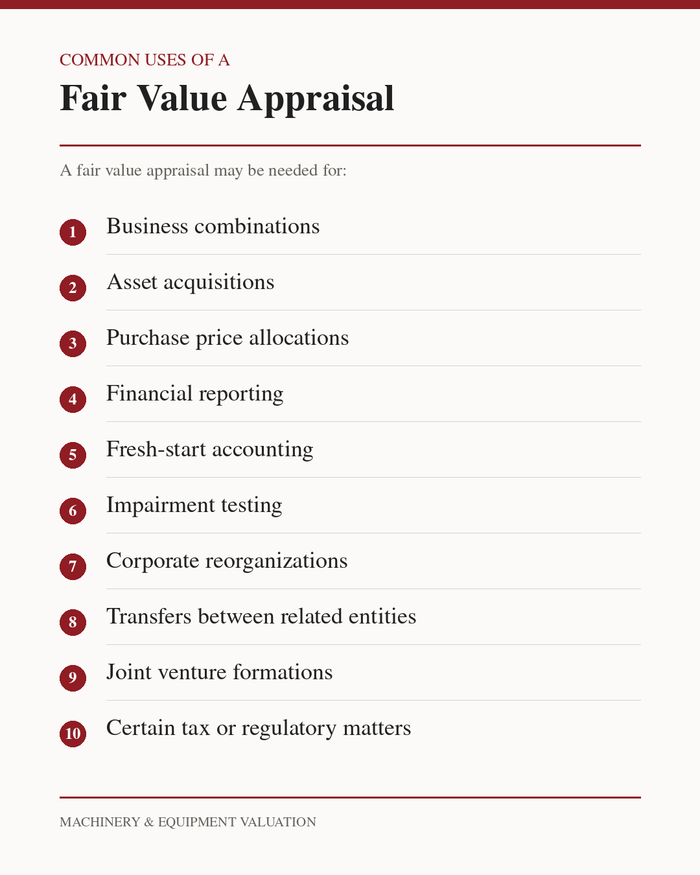
A Fair Value Appraisal may be required whenever a business must report assets at current market-based values. Common situations include:
- Business combinations
- Asset acquisitions
- Purchase price allocations
- Financial reporting
- Fresh-start accounting
- Impairment testing
- Corporate reorganizations
- Transfers between related entities
- Joint venture formations
- Certain tax or regulatory matters
The exact requirements depend on the transaction and the applicable accounting guidance. The company’s accountant or auditor should help define the reporting standard.
The appraiser then develops the appropriate scope of work. This keeps the valuation aligned with the accounting purpose.
Fair Value in a Buy-Sell Transaction
Fair value is often needed when a company purchases another business. It may also be required when a company acquires selected operating assets.
A transaction may include several types of property. These could include real estate, machinery, inventory, customer relationships, trademarks, and other assets.
The total purchase price cannot always be assigned to one category. It must often be divided among the acquired assets and assumed liabilities.
This process is generally called a purchase price allocation. The machinery appraisal supports the portion assigned to tangible personal property.
For example, a buyer may acquire a manufacturing company for $10 million. That amount does not mean the machinery is worth $10 million.
The purchase price may reflect land, buildings, working capital, equipment, intangible assets, and goodwill. Each category requires separate consideration.
How Purchase Price Allocation Works
In a business combination, the buyer generally recognizes identifiable assets and liabilities at their acquisition-date fair values. Any remaining amount may be recorded as goodwill.
ASC 805 uses this acquisition-date measurement framework for business combinations.
An asset acquisition may receive different accounting treatment. The acquisition cost is commonly allocated among the acquired assets using their relative fair values.
This distinction is important. A business combination and an asset acquisition are not always accounted for in the same manner.
The company’s accounting advisor should determine which guidance applies. The appraiser should not make that accounting decision independently.
The machinery appraiser provides supported value conclusions for the tangible assets. Accountants then use those conclusions within the overall allocation.
Why Book Value May Not Be Reliable
Book value is an accounting amount. It usually reflects original cost less accumulated depreciation.
That figure may have little relationship to current fair value. Accounting depreciation schedules do not always match actual market behavior.
A fully depreciated machine may still operate effectively. It may also have a meaningful secondary-market value.
The opposite situation can also occur. A newer asset may have a book value that exceeds its current market value.
Technology changes can reduce demand quickly. Loss of manufacturer support may also affect marketability.
Original cost can provide useful information. However, original cost alone does not establish fair value.
How Machinery and Equipment Are Valued
The appraiser considers the Cost, Sales Comparison, and Income Approaches. The relevance of each approach depends on the assets and available data.
The Cost Approach begins with the current cost of a comparable new asset. The appraiser then considers all applicable forms of depreciation.
Physical depreciation reflects age, wear, condition, and remaining utility. Functional obsolescence may result from design limitations or outdated technology.
Economic obsolescence arises from conditions outside the asset. These conditions may include reduced industry demand, excess capacity, or regulatory changes.
The Sales Comparison Approach examines similar equipment in the secondary market. Sources may include dealer listings, auction results, and documented sales.
Adjustments may be required for age, condition, capacity, location, accessories, hours, or production use.
The Income Approach is less common for individual machinery. Most machines do not generate a separately identifiable income stream.
An appraiser may use more than one approach. The final conclusion for a Fair Value Appraisal should reflect the quality and relevance of the available evidence.
Fair Value Compared With Fair Market Value
Fair Value and Fair Market Value are related terms, but they are not automatically interchangeable.
Fair Market Value generally assumes a willing buyer and a willing seller. Neither party is under compulsion, and both understand the relevant facts.
Fair value is normally tied to a specific accounting framework. It focuses on market participants, the measurement date, and an orderly exit transaction.
The proper definition should always appear in the appraisal report. The intended use should also be clearly stated.
Using the wrong value definition can create problems during an audit. It may also produce an allocation that does not match the applicable accounting requirements.
Installed Value and the Unit of Account
Industrial machinery may have value as part of an installed operating system. Installation can include freight, rigging, foundations, wiring, piping, engineering, and testing.
These costs can be substantial. They may contribute value when market participants would consider them within the applicable unit of account.
However, not every installation cost adds value dollar for dollar. Some costs may be site-specific or unnecessary to another buyer.
The appraisal must distinguish between cost and value. It must also identify whether the assets are valued individually or as an integrated group.
This issue is especially important for production lines, process systems, paint booths, furnaces, and other installed equipment.
Information Needed for the Appraisal
A reliable appraisal begins with an accurate asset listing. The schedule should include enough information to identify each major asset.
Helpful information may include:
- Manufacturer and model
- Serial number
- Year manufactured
- Acquisition date
- Original acquisition cost
- Installation cost
- Equipment location
- Hours or production use
- Maintenance history
- Current operating condition
- Major accessories and upgrades
- Photographs of the equipment
- Planned continued use
The appraiser may also review invoices, fixed-asset records, and prior appraisal reports.
An on-site inspection can improve asset identification. It also allows the appraiser to observe apparent condition and installed configuration.
A desktop appraisal may be appropriate in some situations. However, the appraiser should clearly disclose its limitations.
Why Appraiser Qualifications Matter
Fair value assignments often receive review from accountants, auditors, attorneys, and company management.
The report must contain more than unsupported estimates. It should explain the data, methods, assumptions, and reasoning behind the conclusions.
The appraiser should also have experience with the subject equipment. Industrial machinery can require specialized knowledge of markets and installation requirements.
An ASA-designated machinery and equipment appraiser has completed education and experience requirements within the appraisal profession. The appraiser must also follow recognized ethical and reporting standards.
Independence is equally important. The appraiser’s compensation cannot depend on reaching a predetermined value or supporting a desired allocation.
Supporting a Defensible Financial Allocation
A Fair Value Appraisal helps businesses assign supportable values to acquired machinery and equipment. It is particularly important during purchase price allocation and other acquisition-related accounting.
The analysis bridges the transaction and the company’s financial records. It helps explain how much value belongs to tangible operating assets.
A strong appraisal identifies the assets, applies the correct definition, and uses relevant market evidence. It also clearly discloses important assumptions and limitations.
When properly developed, the appraisal can support management, accountants, and auditors. It can also reduce questions during financial reporting reviews.