
When a business acquires machinery, equipment, furniture, vehicles, or other fixed assets, simply recording a lump-sum purchase price is often insufficient. Accounting standards require that the purchase price be allocated among the acquired assets based on their respective fair values. This process, known as a Cost Allocation Appraisal, establishes the basis for depreciation, financial reporting, and future financial analysis.
An independent appraisal provides objective support for these allocations and helps ensure that financial statements accurately reflect the value of the acquired assets.
What Is a Cost Allocation Appraisal?
A Cost Allocation Appraisal is an independent valuation of tangible assets used to allocate an overall purchase price or carrying value among individual assets or asset classes.
Typical assets included in a cost allocation assignment include:
- Manufacturing machinery
- Construction equipment
- Medical equipment
- Restaurant equipment
- CNC machinery
- Material handling equipment
- Vehicles and fleet assets
- Office furniture and fixtures
- Computer and IT equipment
- Warehouse equipment
The appraisal determines the fair value of each asset or asset category, creating a supportable allocation for accounting purposes.
GAAP Requirements for Cost Allocation
Several sections of the Financial Accounting Standards Board (FASB) Accounting Standards Codification (ASC) govern cost allocation.
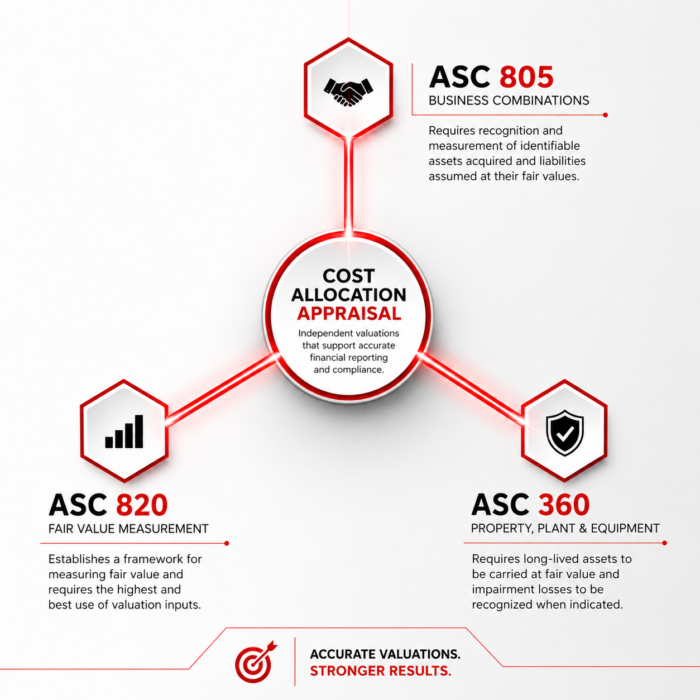
ASC 805 – Business Combinations
ASC 805 requires that when a business is acquired, the purchase price be allocated among the identifiable assets acquired and liabilities assumed based on their acquisition-date fair values.
This process is commonly referred to as a purchase price allocation (PPA). For tangible assets such as machinery and equipment, an independent appraisal provides the objective valuation necessary to support the allocation.
ASC 820 – Fair Value Measurement
ASC 820 establishes the framework for determining fair value whenever GAAP requires a fair value measurement.
Rather than prescribing a specific valuation method, ASC 820 defines how fair value should be measured using market participant assumptions, highest and best use concepts, and accepted valuation methodologies.
Professional appraisers apply these principles when determining the fair value of machinery and equipment.
ASC 360 – Property, Plant, and Equipment
Once assets have been recorded, ASC 360 governs their ongoing accounting, including depreciation, impairment testing, and disposal.
An accurate initial allocation is important because depreciation expense and future carrying values depend on the original assigned values.
Why Businesses Need a Cost Allocation Appraisal
Many organizations assume cost allocation only applies during mergers or acquisitions. In reality, there are numerous situations where an independent appraisal is beneficial.
Common reasons include:
- Business acquisitions
- Asset acquisitions
- Internal corporate restructurings
- Parent and subsidiary asset transfers
- Financial reporting
- Purchase accounting
- Establishing depreciation schedules
- Capital budgeting
- Investor reporting
- Lender requirements
A professionally prepared appraisal provides documentation that management, auditors, lenders, and investors can rely upon.
Cost Allocation Appraisal Case Example
A regional manufacturing company recently acquired a competitor for $8 million. The transaction included dozens of CNC machining centers, forklifts, material handling equipment, quality control instruments, warehouse racking, office furniture, and computer systems.
After the acquisition closed, the company’s CFO faced an important question: How should the purchase price be allocated among the acquired assets? Simply assigning estimated percentages to each asset category would not provide the level of support needed for GAAP financial reporting or an external audit.
The company engaged an independent appraiser to perform a Cost Allocation Appraisal. The appraisal team inspected the assets, researched current market data, estimated replacement costs, and analyzed depreciation to determine the fair value of each asset category. The completed appraisal established a well-supported allocation that management could confidently use for its financial statements and depreciation schedules.
Several months later, the company’s external auditors requested documentation supporting the recorded asset values. Rather than relying on internal estimates or spreadsheets, management provided the independent Cost Allocation Appraisal report. The appraisal offered objective, third-party support for the allocated values, allowing the audit to move forward efficiently and giving management confidence that its financial reporting complied with applicable accounting standards.
Why Independence Matters
Internal estimates often rely on book values, historical costs, or arbitrary percentages. Unfortunately, these methods frequently fail to reflect current fair value.
An independent machinery and equipment appraiser evaluates factors such as:
- Current replacement cost
- Physical condition
- Remaining useful life
- Functional utility
- Market demand
- Comparable sales
- Industry trends
This results in a defensible allocation supported by recognized valuation methodology rather than assumptions.
Industries That Frequently Require Cost Allocation Appraisals
We regularly perform Cost Allocation Appraisals for businesses across numerous industries, including:
- Manufacturing
- Food processing
- Medical and healthcare
- Construction
- Transportation
- Aerospace
- Hospitality
- Warehousing and distribution
- Energy
- Printing
- Plastics
- Metal fabrication
- Packaging
- Agricultural operations
Regardless of industry, properly identifying and valuing fixed assets improves the accuracy of financial reporting.
The Benefits of a Professional Cost Allocation Appraisal
A professionally prepared appraisal can help organizations:
- Support GAAP-compliant financial reporting
- Provide objective documentation for auditors
- Establish accurate depreciation schedules
- Improve asset management
- Support financing transactions
- Assist with corporate restructurings
- Reduce disputes regarding asset values
- Provide credible documentation for stakeholders
Most importantly, it creates an independent record of asset values that can withstand scrutiny from auditors, lenders, investors, and other interested parties.
Why Choose Truman Mox?
At Truman Mox, we perform machinery and equipment appraisals throughout the United States for businesses of all sizes. Our appraisals are prepared by Accredited Senior Appraisers (ASA) and are developed in accordance with USPAP standards.
Whether your company is acquiring a manufacturing facility, purchasing a medical practice, buying restaurant equipment, or allocating assets following a corporate transaction, we provide independent, well-supported valuations tailored to your accounting and financial reporting needs.
If your organization requires a Cost Allocation Appraisal, contact Truman Mox to discuss your project. Our team can help provide the independent valuation support necessary for accurate financial reporting and informed business decision-making.