
Business asset valuation is an important step for companies preparing to sell. While revenue, profitability, customer relationships, and operational performance all influence transaction value, physical assets can also play a significant role. Machinery, equipment, vehicles, technology systems, warehouse assets, and production infrastructure often contribute meaningfully to overall business value and can affect buyer confidence during the sale process.
A professional business asset valuation helps company owners understand the current value of their physical assets before entering the sale process. Accurate equipment valuation and machinery valuation can support pricing discussions, reduce uncertainty, and provide buyers with reliable documentation during due diligence.
For companies preparing for a merger, acquisition, succession plan, or private sale, independent asset appraisal services can create a stronger foundation for negotiation. Instead of relying only on book value or internal estimates, business owners can use market-based valuation reporting to better understand the true value of their equipment and operational assets.
Why Business Asset Valuation Matters Before a Sale
Business owners often invest heavily in machinery, production equipment, fleet assets, technology infrastructure, and other revenue-generating assets over many years. However, accounting records do not always reflect current market value. Some assets may be fully depreciated on paper but still hold meaningful resale or operational value. Others may appear valuable on a balance sheet but have limited market demand due to age, condition, or technology changes.
This is why business asset valuation is important during business sale preparation. A professional valuation helps owners identify what their assets are worth in the current market, which can support stronger conversations with buyers, investors, and lenders.
Buyers also want transparency. When a company can provide independent valuation documentation, the transaction process often becomes more efficient and credible. Accurate industrial asset valuation reduces uncertainty and helps establish realistic expectations before negotiations begin.
Understanding Business Asset Valuation for Business Sales
A business asset valuation is the process of determining the current value of a company’s physical and operational assets. This may include machinery, equipment, vehicles, technology systems, warehouse infrastructure, and specialized tools used in daily operations.
Professional valuation reports often consider fair market value, replacement cost, condition, age, depreciation, resale demand, and remaining useful life. Depending on the purpose of the assignment, the valuation may also consider orderly liquidation value or forced liquidation value.
For companies preparing to sell, fair market value is often especially important because it reflects what a willing buyer may reasonably pay for the assets under normal market conditions. This helps both sellers and buyers understand the role equipment plays in the overall purchase price.
A strong valuation report can also support merger and acquisition valuation, lender review, investor presentations, internal planning, and long-term asset management decisions.
Key Equipment Assets Buyers Evaluate During Acquisitions
When buyers review a company, they often look closely at the equipment and infrastructure required to keep the business operating. These assets can directly affect production capacity, service quality, operating costs, and future capital investment needs.
Modern, well-maintained assets may improve buyer confidence because they suggest the company can continue operating without immediate replacement costs. On the other hand, outdated or poorly maintained equipment may raise concerns about future expenses.
Common Assets Included in Business Asset Valuation
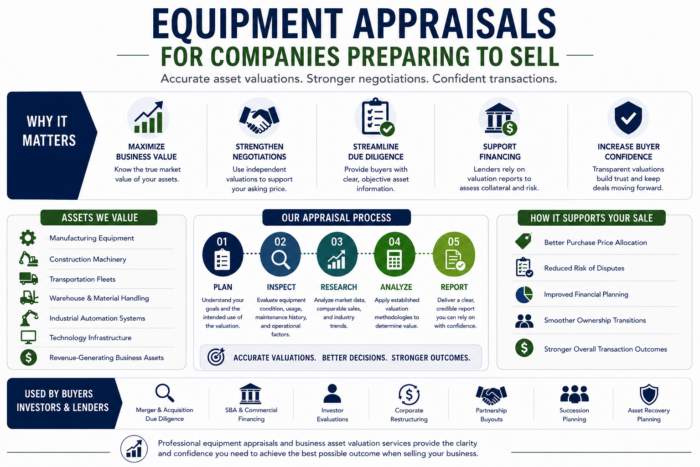
- Manufacturing equipment
- Construction machinery
- Transportation fleets
- Warehouse assets
- Material handling equipment
- Industrial automation systems
- Technology infrastructure
- Revenue-generating business assets
Professional equipment appraisals and machinery appraisals help identify the value of these assets while giving buyers a clearer understanding of condition, marketability, and future usefulness.
How Equipment Appraisals Support Business Sale Negotiations
One of the most valuable aspects of professional appraisal is its ability to support negotiations with objective market data. Sellers may believe their assets are worth more because they understand the history and usefulness of the equipment. Buyers may take a more conservative view because they are focused on risk, replacement costs, and future capital needs.
An independent appraisal provides a neutral reference point. Instead of relying on assumptions, both parties can review documented value conclusions based on condition, market research, depreciation, and comparable sales activity.
This can be especially helpful when equipment represents a large percentage of the company’s total value. In industries such as manufacturing, logistics, construction, distribution, and industrial services, equipment assets often play a major role in purchase price discussions.
Accurate valuation can also support financing. If a buyer is using lender financing, the lender may want to review asset values to understand collateral strength and transaction risk. In these situations, valuation reporting may help keep the sale process moving forward.
Common Assets Included in Business Asset Valuation
Business asset valuation can be complex because companies often own many different asset types purchased over several years. Some assets may have complete maintenance records, while others may have limited documentation. Some equipment may be customized for specific operations, making market comparisons more difficult.
Technology changes can also affect value. Equipment that remains functional may still lose market demand if newer systems offer better automation, efficiency, or compatibility. At the same time, certain older assets may retain value because they are durable, reliable, or difficult to replace.
Market conditions can also shift quickly. Supply chain disruptions, industry demand, inflation, labor shortages, and changes in buyer activity may all influence equipment pricing. These factors make professional valuation important for companies that want accurate and current reporting before entering a sale process.
Good equipment lifecycle management can improve valuation outcomes because buyers often prefer assets with clear maintenance histories, consistent service records, and predictable replacement timelines.
How Buyers and Investors Use Asset Valuation Reports
- Merger and acquisition due diligence
- SBA and commercial financing
- Investor evaluations
- Ownership transitions
- Corporate restructuring
- Partnership buyouts
- Succession planning
- Asset recovery planning
Why Professional Equipment Appraisals Increase Transaction Confidence
Preparing a company for sale requires accurate information. Professional valuation reporting gives business owners, buyers, investors, and lenders a clearer understanding of asset value before major decisions are made.
A business asset valuation can support stronger negotiations, improve due diligence, and reduce uncertainty during ownership transitions. It can also help sellers identify underappreciated assets, evaluate replacement needs, and present a more complete picture of the company’s operational value.
As business transactions become increasingly sophisticated, professional asset appraisal services continue to play an important role in mergers, acquisitions, succession planning, and private business sales. Companies that understand the value of their physical assets are often better prepared to communicate value and move confidently through the transaction process.
Companies seeking professional valuation support can learn more about equipment valuation services at Truman Mox and explore additional industry insights through Truman Mox News.