

In an increasingly interconnected global economy, organizations operate across regions, countries, and even continents, each with its own set of assets, equipment, and infrastructure. As businesses expand, the need for consistent, transparent, and data-driven valuation across all holdings has never been greater. This is where multi-site asset appraisals come into play.
Managing multi-site asset appraisals is both a science and a strategy. It requires balancing on-the-ground asset insights with a global perspective, ensuring that each site’s unique characteristics are captured while still maintaining consistency across the broader asset base.
The Complexity of Multi-Site Asset Appraisals
Conducting a single-site appraisal is already a multifaceted process involving documentation review, physical inspection, market analysis, and reconciliation. Now multiply that by 20, 50, or even 100 locations, each with different operational conditions, maintenance practices, and regulatory frameworks.
The complexity of multi-site asset appraisals lies in managing this diversity efficiently. Every asset must be understood in context:
- Operational Context – How heavily is the asset used? What is its maintenance schedule?
- Geographic Context – How do environmental or regional factors affect its condition and value?
- Regulatory Context – Are there local compliance standards that impact valuation?
Without a unified methodology, inconsistencies can quickly arise, leading to inaccurate valuations, misinformed decisions, and compliance risks.
Standardization: The Foundation of Reliable Multi-Site Appraisal
To ensure consistent results, multi-site appraisals must be built upon standardized methodologies. This means using uniform data collection templates, valuation approaches, and depreciation models across all locations.
Key elements of standardization include:
- Asset Classification Frameworks – Establish consistent naming conventions and asset categories across all sites.
- Uniform Data Collection Tools – Use identical forms, inspection checklists, and digital systems to ensure data compatibility.
- Valuation Methodology Alignment – Apply the same valuation basis (e.g., fair market value, replacement cost new) to each asset category.
- Consistent Reporting Formats – Deliver unified reports that allow seamless cross-comparison between sites.
This standardization forms the backbone of a scalable, repeatable appraisal process that can grow alongside an expanding organization.
Sampling Assets to Gain Clarity on the Whole
When an organization owns thousands of assets across multiple locations, inspecting every single one may not be practical. The time, cost, and logistical effort required can outweigh the benefits, especially when the majority of assets fall into repeatable, predictable categories.
Conducting full physical inspections across dozens of facilities can be time-intensive and disruptive to operations. In some cases, temporary relocation or storage of equipment may be required to facilitate inspections. Services like PODS offer scalable container-based storage solutions that can support asset organization between appraisal phases.
That’s why sampling is an essential strategy in multi-site appraisals. Appraisers select a statistically representative subset of assets from each site that reflects the diversity of the entire portfolio.
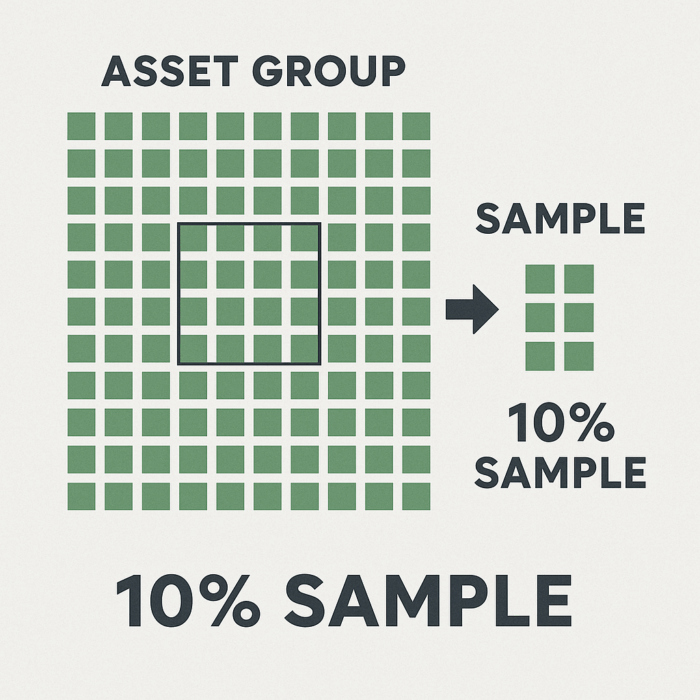
For example:
- In a manufacturing network, appraisers might inspect 20% of machinery from each production line.
- In a real estate portfolio, they might review a select number of similar warehouse sites to infer values for others.
- For IT or equipment-intensive operations, a sample of each asset type (servers, workstations, vehicles, etc.) may suffice.
This sampling provides a clear, data-rich snapshot of asset conditions, usage, and market relevance, without the inefficiency of full physical coverage.
Extrapolating Findings Across the Portfolio
Once the sample data has been gathered, the next step is extrapolating findings to represent the entire asset base. This process involves careful statistical analysis, validation, and calibration to ensure accuracy.
Here’s how appraisers typically approach this:
- Define Asset Groups – Group assets by category, function, or condition.
- Calculate Averages and Variability – Determine key metrics (age, condition, utilization) for the sampled group.
- Apply Statistical Weighting – Assign proportional weights to extrapolate the findings across all similar assets.
- Validate with External Data – Cross-reference with previous appraisals, market data, and historical depreciation curves.
- Adjust for Outliers – Identify and account for unique assets or sites that significantly differ from the average.
This method turns a limited but strategic dataset into a comprehensive, defendable valuation framework, maintaining both efficiency and integrity.
Technology’s Role in Multi-Site Asset Appraisals
Modern asset appraisal no longer relies solely on manual processes. Technology now plays a crucial role in ensuring speed, consistency, and transparency.
- Cloud-Based Appraisal Platforms – Centralize data collection, reporting, and collaboration between sites.
- AI-Powered Analytics – Detect patterns, outliers, and asset trends across locations.
- Geospatial Mapping – Visualize asset distribution and regional valuation differences.
- Digital Twins and IoT Integration – Provide real-time performance and condition data for more accurate valuations.
These tools not only streamline multi-site appraisals but also enhance the long-term management of enterprise assets.
The Strategic Benefits of Multi-Site Asset Appraisals
Beyond compliance and reporting, multi-site appraisals deliver critical strategic value to the business. When done properly, they enable:
- Capital Planning and Budgeting – Clear visibility into asset values helps prioritize reinvestment and replacement.
- Insurance Optimization – Ensures adequate coverage levels and avoids over- or under-insuring assets.
- Mergers and Acquisitions Support – Provides transparent valuations that facilitate negotiations and due diligence.
- Operational Efficiency – Highlights underperforming or redundant assets for redeployment or disposal.
- Risk Mitigation – Identifies assets at higher risk of failure or devaluation before they become liabilities.
Ultimately, multi-site appraisals transform raw asset data into actionable business intelligence.
Best Practices for Successful Multi-Site Appraisals
- Plan Ahead – Establish clear goals, timelines, and data standards before starting.
- Collaborate with Local Teams – Local insight improves accuracy and ensures access to critical data.
- Leverage Sampling Strategically – Tailor sampling approaches to asset type, complexity, and variability.
- Ensure Quality Control – Conduct periodic cross-site reviews to maintain consistency.
- Document Thoroughly – Keep detailed records of assumptions, data sources, and valuation methods.
By integrating these best practices, organizations can turn appraisal complexity into a streamlined, repeatable process that scales effortlessly.
Turning Complexity into Clarity
“Appraising without borders” is more than a concept, it’s a commitment to accuracy and transparency across every site, every region, and every asset. Through multi-site asset appraisals, organizations gain a unified, 360-degree understanding of their entire asset base.
By combining smart sampling strategies, advanced analytics, and standardized methodologies, businesses can achieve global consistency without sacrificing local precision. The result? Better decisions, stronger financial confidence, and a foundation for growth that’s built on clarity rather than complexity.